First Time Buyer Series – Buying Your First Home
Buying your first home is one of the most exciting things you’ll ever do. It’s also a step into something new and unfamiliar which brings a feeling of uncertainty to go with the excitement. This is completely normal and for the majority of buyers, you’ll follow a clear path from thinking about your first home to buying your first home. Once you know what each stage of the buying process looks like, it stops feeling daunting and starts feeling doable.
This is part one of our first-time buyer series where we give you an overview of the whole journey from start to finish. In the parts that follow, we’ll look at how family and friends can help you onto the ladder and how to understand the different mortgage options open to you. For now, here’s the big picture, stage by stage, with the practical detail that makes each step easier.
What Can You Afford?
Before you fall in love with a property, it helps to know your numbers. Your budget comes down to three things: how much deposit you’ve saved, how much a lender will offer you and what you can comfortably repay each month.
Your Deposit
Most lenders will want a deposit of at least 5% of the property price, although a bigger deposit usually unlocks better rates. Every extra 5% you put down moves you into a lower loan-to-value band and that can make a real difference to your monthly payments.
How much you can borrow.
Most lenders will lend somewhere around four to four and a half times your income, with some going higher for certain incomes and professions. But the multiple is only part of the story. Lenders also look closely at your outgoings, including credit cards, car finance, childcare and regular commitments, to judge what’s genuinely affordable.
The costs beyond the deposit.
This is where first-time buyers are most often caught out. Alongside your deposit, it’s worth budgeting for:
- Solicitor or conveyancer fees
- A survey on the property
- Any mortgage arrangement or valuation fees
- Moving costs and the first few things you’ll need for the new place
- Stamp duty, if applicable
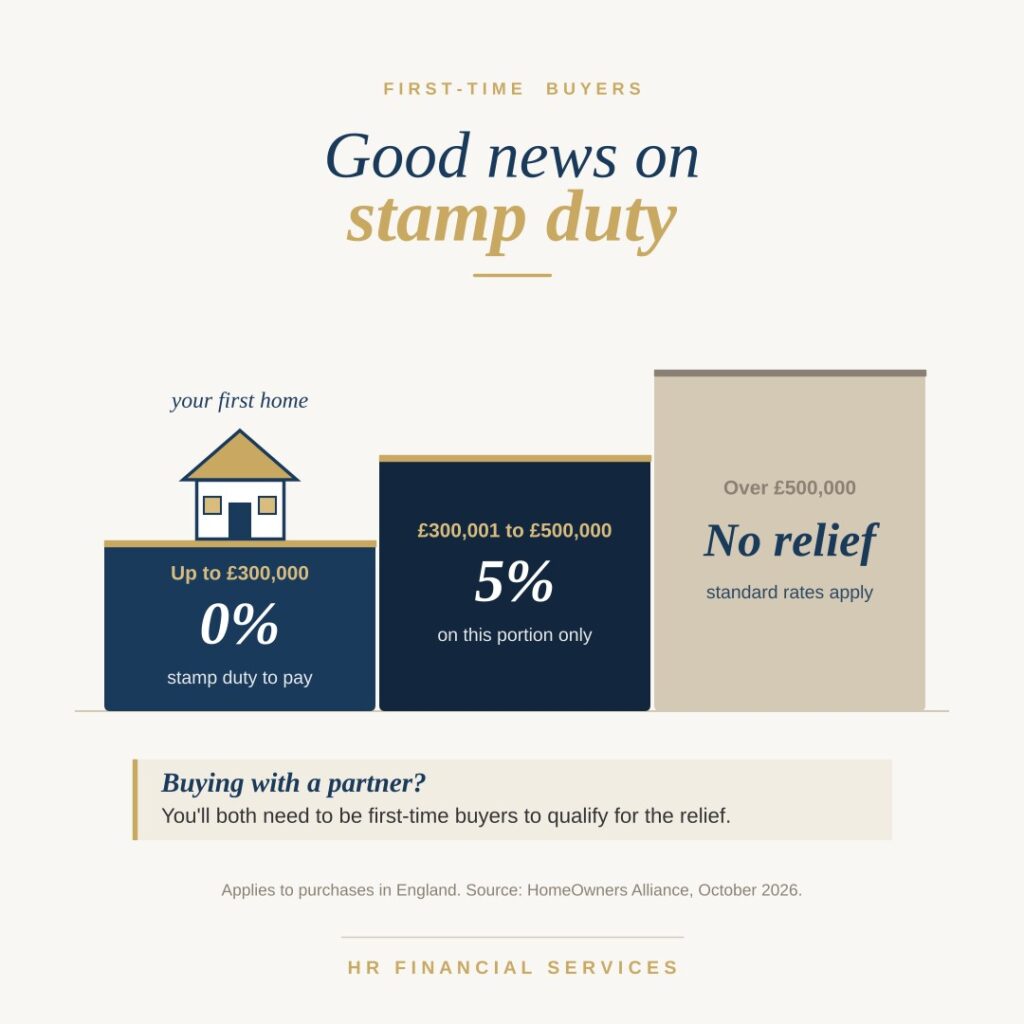
On that last point, there’s good news. First-time buyers in England pay no stamp duty on the first £300,000 of the purchase price, then 5% on the portion between £300,001 and £500,000. If the property costs more than £500,000, the first-time buyer relief is not available at all and standard rates apply to the entire purchase price. One detail worth knowing if you’re buying with a partner you can only qualify for first-time buyer relief if you’re both first-time buyers, according to HomeOwners Alliance.
Saving schemes.
If you’re still building your deposit, the Lifetime ISA remains available for now, with a government bonus on top of what you save. Change is on the way, though. The government launched a consultation on 23 June proposing a new First Time Buyer ISA to replace the Lifetime ISA, with the upper age limit and withdrawal penalties scrapped, as reported by HomeOwners Alliance. The proposals aren’t law yet, so if you’re weighing up your options, it’s well worth talking it through with us.
Note: The Lifetime ISA information above is correct as of September 2026 and may change in the future.
Get your credit file in shape.
Check your credit report with the main agencies, make sure you’re registered on the electoral roll at your current address and keep up with existing repayments. Small fixes here can make a noticeable difference to the deals available to you.
This is the best possible place to start a conversation with us. We’ll help you understand what’s realistic, what the monthly payments would actually look like and how to position yourself as strongly as possible before you even start viewing.
Get Your Agreement in Principle
An Agreement in Principle, sometimes called a Decision in Principle, is a lender’s early indication of how much they’d be willing to lend you. It’s quick to arrange and it does two important things: it gives you a clear budget to shop within and it shows estate agents and sellers that you’re a serious buyer.
What you’ll need. Usually just the basics: proof of identity, your address history, details of your income and an idea of your regular outgoings. Having your last three months of payslips and bank statements ready will speed things up later too.
How long it lasts. Most Agreements in Principle are valid for somewhere between 30 and 90 days, depending on the lender. If your search runs longer, it can simply be renewed.
Credit checks. Some lenders use a soft search at this stage, which won’t affect your credit score, while others carry out a full check. As your broker, we’ll know which approach each lender takes, so you’re not leaving unnecessary marks on your file.
In a competitive market, having this in place before you view can be the difference between your offer being taken seriously and being passed over. It’s one of the simplest, highest-impact steps you can take early on.
Searching & Offers For Homes
Now comes the fun part. With your budget clear and your Agreement in Principle ready, you can view properties knowing exactly what’s within reach.
Go back for a second look if you’re serious, ideally at a different time of day. Check the things that are harder to change such as the condition of the roof and windows, signs of damp, water pressure, phone signal, parking and the commute. Ask the agent how long the property has been on the market and why the sellers are moving.
Making your offer. When you find the one, you make an offer through the estate agent. Look at what similar homes nearby have sold for, rather than only what they were listed at, so your offer is grounded in reality. As a first-time buyer, you have a real advantage here with no property to sell, you’re not part of a chain and sellers value that. Make sure the agent knows it.
There’s often a little back and forth before a price is agreed. Don’t be put off if your first offer isn’t accepted. It’s a normal part of the process and having your finances lined up means you can move quickly and confidently when the right moment comes.
Make The Most of Viewings
Go back for a second look if you’re serious, ideally at a different time of day. Check the things that are harder to change such as the condition of the roof and windows, signs of damp, water pressure, phone signal, parking and the commute. Ask the agent how long the property has been on the market and why the sellers are moving.
Making Your Offer
When you find the one, you make an offer through the estate agent. Look at what similar homes nearby have sold for, rather than only what they were listed at, so your offer is grounded in reality. As a first-time buyer, you have a real advantage here with no property to sell, you’re not part of a chain and sellers value that. Make sure the agent knows it.
There’s often a little back and forth before a price is agreed. Don’t be put off if your first offer isn’t accepted. It’s a normal part of the process and having your finances lined up means you can move quickly and confidently when the right moment comes.

Applications & Legal
Once your offer is accepted, two things happen in parallel.
Your full mortgage application goes to the lender, along with your supporting documents. The lender arranges a valuation of the property to confirm it’s worth what you’re paying, then issues a formal mortgage offer. Mortgage offers typically remain valid for around three to six months, which gives plenty of time for the legal work to complete.
At the same time your solicitor or conveyancer runs local authority, environmental and drainage searches, reviews the contract and property information from the seller’s side and raises any questions that need answering. It’s worth instructing them as soon as your offer is accepted, as this part often takes the longest.
You the want to get your own survey. The lender’s valuation is for the lender’s benefit, not yours. A separate survey tells you about the condition of the property itself, so any issues are found before you’re committed. The right level of survey depends on the age and type of home you’re buying and we’re happy to point you in the right direction.
This is the stage where having a broker really earns its keep. Everything on the mortgage side from applications to formal offers is handled. They should also keep everything moving, chase where needed and have someone available to explain everything to you in easy to understand terms. You should never be left wondering what’s happening or what comes next.
Completion & Getting The Keys
The final steps are exchange and completion.
At exchange, the sale becomes legally binding. You’ll pay your deposit to the seller’s solicitor via your own and a completion date is fixed. Exchange is also usually the point at which you need buildings insurance in place, as the property becomes your responsibility from that moment.
At completion, the mortgage funds are released, the money changes hands, the property becomes yours and you collect the keys. That’s the moment it all becomes real.
There’s a little admin that follows. Your conveyancer handles stamp duty, which must be paid within 14 days of completion and registers you as the new owner with the Land Registry. On your side, it’s a case of setting up utilities, council tax and updating your address. By then the hard part is behind you and you’re standing in your first home.

Organising Protection
It’s easy to overlook in the excitement, but the moment you take on a mortgage is exactly when protecting it matters most. Your home is likely to be the biggest commitment you’ve ever made and the right cover means it stays secure whatever life brings.
- Life insurance pays out to clear or reduce the mortgage if the worst happens, so the people you live with keep their home.
- Income protection replaces part of your income if illness or injury stops you working, so the mortgage keeps getting paid while you recover.
- Buildings cover protects the structure of the property itself and is a requirement of almost every mortgage.
We’ll help you put the right cover in place so your first home is protected from day one.
A Partner With You Every Step of the Way
The best part of all this? You don’t have to work any of it out alone. We guide first-time buyers through this exact journey every week and our job is to make it feel simple, clear and even enjoyable.
Whenever you’re ready, whether that’s today or six months from now, we’d love to help you take the first step.